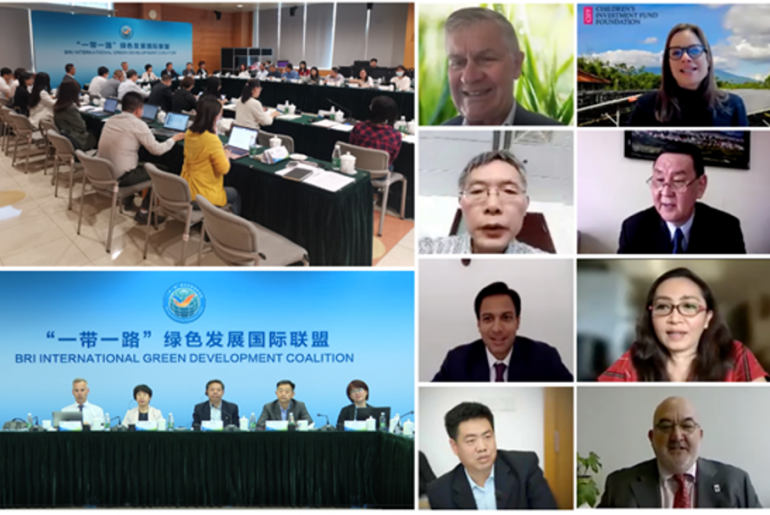
On June 23, 2021, during a virtual conference, political leaders of 29 partner countries of the Belt and Road initiative (BRI) launched the Initiative for Belt and Road Partnership on Green Development (“BRI Green Partnership”). Chinese State Councilor and Foreign Minister WANG Yi presided over the conference during the Asia and…
Highlights Download pdf Between 2014 and 2020, about USD160 billion of Chinese-backed coal-fired power plants were being planned or announced outside of China;More than USD65 billion of Chinese-backed coal-fired power plants have been either shelved, mothballed or cancelled since 2014, with more projects seeing delays in construction;In 2019 and 2020,…
1. Introduction The COVID-19 pandemic has brought extreme stress to the global economy. Governments around the world are trying solutions to tackle the economic crisis through various fiscal, monetary, and related stimulus packages. Policymakers are struggling to balance their stimulus between the immediate “rescue” phase and the longer-term “recovery” phase:…
On 17 May 2021, a Roundtable on the Green Development Guidance for BRI Projects was held by BRI International Green Development Coalition (BRIGC), World Resources Institute (WRI) and ClientEarth in Beijing. Chinese and international speakers joined the conference both online and on site. International-Roundtable-on-the-Green-Development-Guidance-for-BRI-Projects Background The BRI International Green Development…
Discontent and activism against BRI initiatives pose financial risks and spell potential public image problems for China and host countries. Understanding the social and economic motivations of communities who protest and how to prevent future mobilisations is essential to the success of the BRI in Central Asia. A quintessential example…
The BRI offers the Central Asian range states of Panthera Uncia a once in a generation chance to bring economic opportunity to a region often overlooked in development. Like all projects of this scale, the ramifications for the area’s biodiversity, and in particular its flagship species Panthera Uncia remains hard…
Introduction Whilst the BRI is led by Chinese industry, the private sector is cautious in its implementation of environmental protection, especially regarding biodiversity conservation.1 Chinese BRI financiers lack international best-practice safeguards, whilst the whole project may impact more than 369 000 km2 of vulnerable habitat in a 25 km buffer…
China announced coal phase-out in Bangladesh In February 2021, China’s embassy in Bangladesh sent a letter to the local Ministry of Finance stating that “the Chinese side shall no longer consider projects with high pollution and high energy consumption, such as coal mining [and] coal-fired power stations”. Why did China…
Kazakhstan’s energy grid has not been modernised since its independence from the Soviet Union and is falling into a state of dereliction and disrepair. With its sights set on 50 percent renewable energy by 2050 and substantial solar and wind energy capabilities, Kazakhstan could be a model for green energy…
Central Asia is in need of development, energy, and infrastructure, and the BRI can offer these. However, as a region facing transboundary disputes, food and water security problems, and corruption, regulations and incentives must be put in place to ensure the BRI also accounts for the long-term health of people…