Author

Christoph NEDOPIL WANG

Browsing

Dr. Christoph NEDOPIL WANG is the Founding Director of the Green Finance & Development Center and a Visiting Professor at the Fanhai International School of Finance (FISF) at Fudan University in Shanghai, China. He is also the Director of the Griffith Asia Institute and a Professor at Griffith University.


Christoph is a member of the Belt and Road Initiative Green Coalition (BRIGC) of the Chinese Ministry of Ecology and Environment. He has contributed to policies and provided research/consulting amongst others for the China Council for International Cooperation on Environment and Development (CCICED), the Ministry of Commerce, various private and multilateral finance institutions (e.g. ADB, IFC, as well as multilateral institutions (e.g. UNDP, UNESCAP) and international governments.


Christoph holds a master of engineering from the Technical University Berlin, a master of public administration from Harvard Kennedy School, as well as a PhD in Economics. He has extensive experience in finance, sustainability, innovation, and infrastructure, having worked for the International Finance Corporation (IFC) for almost 10 years and being a Director for the Sino-German Sustainable Transport Project with the German Cooperation Agency GIZ in Beijing.


He has authored books, articles and reports, including UNDP's SDG Finance Taxonomy, IFC's “Navigating through Crises” and “Corporate Governance - Handbook for Board Directors”, and multiple academic papers on capital flows, sustainability and international development.

This article was originally published on China Dialogue under a Creative Commons licence. It will be a gargantuan task for China to make good on its recent pledge to become carbon neutral by 2060. Currently, it contributes about 26% of global carbon emissions, its economy is still rapidly developing, and many of its sectors and…
On October 26, 2020, five Chinese government ministries/regulators jointly issued the “Guidance on promoting investment and financing to address climate change” (find original here and an unofficial English translation here) – in short “Climate Finance Guidance”. The Climate Finance Guidance came weeks after Chinese President Xi’s announcement at the United…

On September 21, 2020, the aerospace giant Airbus announced concept designs for “ZEROe”, a zero-emission, hydrogen-powered airplane that would enter service by 2035. While it might be difficult to imagine traveling on a hydrogen-powered plane, hydrogen as a fuel is not new: liquid hydrogen has served as a rocket propellant…

The first six months of 2020 BRI investments show highest share of renewable energy investment, amid a 50% decline in total BRI investments Overall BRI investment trends Download the full report here New data released by the American Enterprise Institute show that most countries of the Belt and Road Initiative…

The year 2020 has proven to be more turbulent than anyone could have expected, and it is only June. While in February we asked if 2020 would be the year of China’s global green leadership, hoping that the Covid-19 virus outbreak would be short-lived, by March we already we had to incorporate broader-than-expected fallout…

Starting on May 21, 2020 and ending on May 28, 2020, China held its National People’s Congress (NPC) and the Chinese People’s Political Consultative Congress (CPPCC) – commonly known as the „two sessions“ or 两会 (Liang Hui). The two sessions were clearly influenced by the Covid19 outbreak: the sessions had…

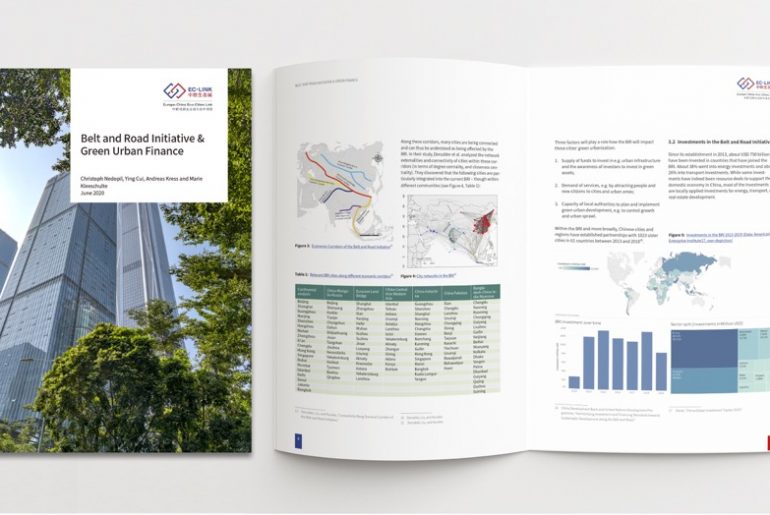
Sustainable transport is a key pillar of green development in the Belt and Road Initiative (BRI). Accordingly, the European Union-funded project EC-Link just published a report on Belt and Road Initiative & Sustainable Urban Transport along two other papers on Belt and Road Initiative & Sustainable Urbanization and Belt and Road…