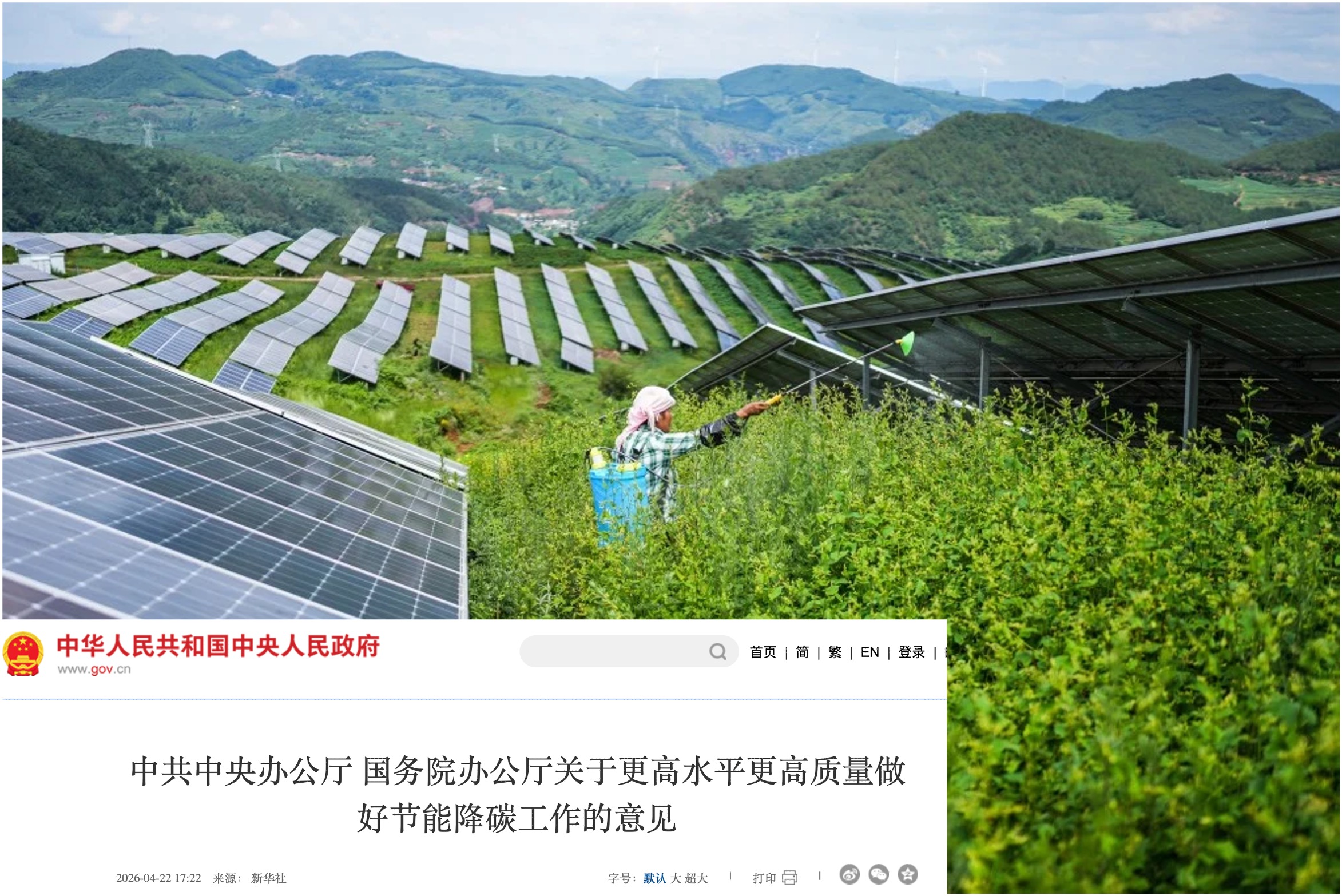
On April 22, 2026, the General Office of the CPC Central Committee and the General Office of the State Council published the Opinions on Doing a Higher-Level and Higher-Quality Job in Energy Conservation and Carbon Reduction.
With these Opinions originating from the leading offices of the Chinese government and the Chinese Communist Party, respectively, only few weeks after the of the “Two Sessions”- the annual plenary sessions of the national People’s Congress and the national Chinese People’s Political Consultative Conference, this document must be understood as highly influential in setting the direction across the Chinese government and party organs for the years to come despite its “Opinion” characters (as opposed to regulations).
The Opinions indeed set out an ambitious tone on China’s green energy transformation focusing on energy conservation and carbon reduction. They include suggestions of strict controls on fossil fuels in energy generation and industrial processes (such as steel).
Overall, the Opinions emphasize more ambitious green energy transition plans than the 15th Five-Year Plan published just weeks before in March 2026 (my analysis of the 15th Five-Year Plan and what it means for China’s green transition can be found here). Importantly, the Opinions are backed up by the “Comprehensive Evaluation and Assessment Measures” issued by the same two organs laying out the responsibilities and processes across the government for the implementation of the opinions.
Overview and Content of the Opinions
The overall goal of the opinions is to strengthen energy conservation, carbon reduction and green transition through a coordinated approach. It affects the most carbon intense industries, addresses some enabling factors like incentives and finance, and lays out clear pathways for the transition including the need for transition plans of new and renovated energy intense industries, as well as the responsibilities for implementation.
Target Industries and Sectors
Energy-and Carbon Intense Industries (e.g., steel, petrochemicals)
Numerous energy-intense industries and sectors have been directly mentioned in the Opinions, including non-ferrous metals, steel, petrochemicals, chemicals with a significant boost in their green transition ambitions and requirements.
Energy-intense industries require measures to reduce energy dependence by improving energy efficiency and applying low-carbon production technologies. This also includes the elimination of outdated and inefficient production capacity, processes, and equipment. To further improve energy conservation, the Opinions stipulate coupling and joint use of facilities for co-production (e.g., steel and chemicals).
Ambitiously, the Opinions suggests that new, renovated, and expanded high energy consuming and high-emission industrial projects to formulate carbon emission replacement plans of equal or reduced amounts as a requirement for approval, verification, and filing procedures.
Industries should also utilize zero-carbon industrial parks and strengthen “green-for-green” models that utilize green energy sources to manufacture green products. The Opinions also highlight the use of digital and intelligent technologies to reduce energy intensity and carbon emissions.
Interestingly, the Opinions address energy security, seemingly linking energy conservation with energy security. This, according to other analyses, would be a significant development of China’s energy policy direction.
Energy
The Opinions stress with significant increase in ambition China’s green energy transition ambitions and fossil fuel controls, including
- Strictly control fossil fuel consumption
- Further promote coal and oil reduction and control
- Gradually push coal and oil consumption to peak
- Strengthen management of new coal and oil demand
- Promote replacement of existing coal-fired boilers and the consumption of green electricity
- control the installed capacity and power generation of coal-fired power plants
- Use coal power for peak shaving (rather than as baseline)
At the same time, the Opinions strengthen the role of clean energy and new power systems, the development of non-fossil energy and energy storage including pumped hydro. It emphasizes the role of microgrids, green power direct connection and the emphasis to reduce grid losses. The stated goal is for clean energy power generation to cover all new electricity demand.
Pricing energy is a core component of the Opinions that highlight the implementation of
- Differentiated electricity pricing policies for key industrial sectors
- Tiered electricity pricing system for residential use
- Time-of-use pricing mechanism
The Opinions, however, don’t include language on the strengthening of energy markets.
Buildings
The Opinions addresses the role of buildings (both public and private) in energy efficiency and carbon reduction – albeit with similar measures as had been mentioned in previous years. Concrete measures are the use of heat metering, energy conservation through building materials, and non-fossil fuels for heating.
Transport
Like its ambitions for buildings, the Opinions highlight the role of transportation systems (including road, rail, water, air) for energy conservation and carbon reduction. Yet, apart from the promotion of battery swapping stations, the importance of “green” railway and waterway transportation, multimodal transportation and route planning efficiencies seem repetitive from previous policies.
Digital Infrastructure
The Opinions highlight the role of digital infrastructure in decarbonization and energy efficiency – which has become an important source of electricity demand. The Opinions thus stress the importance to reduce energy use and carbon emissions from computing, communications and data centres. This also includes the stipulation to develop clear indicators such as electricity utilization efficiency indicators to manage digital infrastructure energy use.
Enabling and supporting mechanisms
Innovation and Talent
The Opinions highlight the importance of strengthening innovation for energy saving and carbon reduction tech. Also, the role of just transition and enhancing work capabilities receive attention in the Opinions.
Procurement, Tax and Finance
The Opinions highlight the role of government investment to support eligible energy savings and carbon reduction projects. National and subnational governments should also use government procurement to promote energy-saving products.
The government should further provide tax incentives for energy conservation projects. To support investment, the government should study the establishment of a national low-carbon transformation fund.
Financial institutions should be supported to provide diversified financial products. However, the Opinions, unlike previous Opinions, do not stress the role of climate finance and do not specify “diversified financial products”.
State-owned enterprises (SOEs) should strengthen demonstration and leadership in energy conservation and carbon reduction, possibly through procurement and investment, as well as through their own transition.
Implementation and Enforcement
The Opinions provide significant input into the enforcement of carbon reduction and energy saving. The implementation and enforcement are further strengthened by the Comprehensive Evaluation and Assessment Measures for Achieving Carbon Peak and Carbon Neutrality” issued by the same organs (see above).
Importantly, all regions and departments as well as political cadres should ensure the effective implementation of the Opinion. As a particular government ministry, the Opinions single out the National Development and Reform Commission (NDRC) – China’s most power ministry. With some previous criticism wielded against NDRC and the National Energy Administration (NEA), which sits under the NDRC, due to their insufficient support for the energy transition, the Opinion’s use of language is strong: the NDRC must “conscientiously” fulfill its responsibility to implement these opinions, while “other departments should perform their respective duties” is telling.
Specifically, the Opinions highlight that regulators should supervise and evaluate the of energy conservation and carbon reduction systems. This should include the
- establishment of energy efficiency and carbon emission disclosure grading systems
- strict energy audits and reviews
- Warnings and alerts for lagging progress towards targets and unreasonable increases in indicators
The punishment of lagging regions, as suggested by the Opinions, could be “project approval delays and restrictions”.
To further strengthen the Opinion’s ambitions, laws and regulations, including the Energy Conservation Law, Renewable Energy Law should be improved.
International collaboration
The Opinions also highlight the ambition to strengthen international collaboration and actively lead international governance. This language is reflective of the 15th Five-Year Plan, and significantly stronger than in e.g., the 2021 Opinions for Building a Green and Low-Carbon Circular Economy (which said “lead and participate in the formulation of international standards”). The Opinions highlight the need to learn from advanced international practices, while also promoting China’s experiences and supporting trade
Interpretation of the Opinions
The Opinions are a significant step for China’s green transition ambition. They clearly strengthen the transition path involving all relevant industries, emphasize the implementation on all levels of government. If previous opinions are a yardstick of the accelerated green industry development, these opinions are important milestone for the peak and phase-down of fossil fuels. They also signal a more ambitious green transition mandate than the 15th Five-Year Plan.
What the Opinions are lacking, however, is a clear time plan beyond the target to peak China’s national emissions in 2030. It seems that the Opinions leave some room for flexibility in this and give the responsibility to the responsible ministries and regulators to establish sector-specific transition timelines.
Finally, what’s also surprising, is the little emphasis of enabling instruments, such as green finance. This could either be a sign of the significant progress made in China’s green finance landscape that is now firmly established. It could, however, also indicate an emphasis of state-led (e.g., SOE) transition with the use of regulatory tools.

Dr. Christoph NEDOPIL WANG is the Founding Director of the Green Finance & Development Center and a Visiting Professor at the Fanhai International School of Finance (FISF) at Fudan University in Shanghai, China. He is also a Professor at The University of Queensland and the lead for Asia Pacific Industry Transitions.
Christoph was a member of the Belt and Road Initiative Green Coalition (BRIGC) of the Chinese Ministry of Ecology and Environment. He has contributed to policies and provided research/consulting amongst others for the China Council for International Cooperation on Environment and Development (CCICED), the Ministry of Commerce, various private and multilateral finance institutions (e.g. ADB, IFC, as well as multilateral institutions (e.g. UNDP, UNESCAP) and international governments.
Christoph holds a master of engineering from the Technical University Berlin, a master of public administration from Harvard Kennedy School, as well as a PhD in Economics. He has extensive experience in finance, sustainability, innovation, and infrastructure, having established the Green Belt and Road Initiative Centre at the International Institute of Green Finance (IIGF) in Beijing, having worked for the International Finance Corporation (IFC) for almost 10 years and being a Director for the Sino-German Sustainable Transport Project with the German Cooperation Agency GIZ in Beijing.
He has authored books, articles and reports, including UNDP's SDG Finance Taxonomy, IFC's “Navigating through Crises” and “Corporate Governance - Handbook for Board Directors”, and multiple academic papers on capital flows, sustainability and international development.