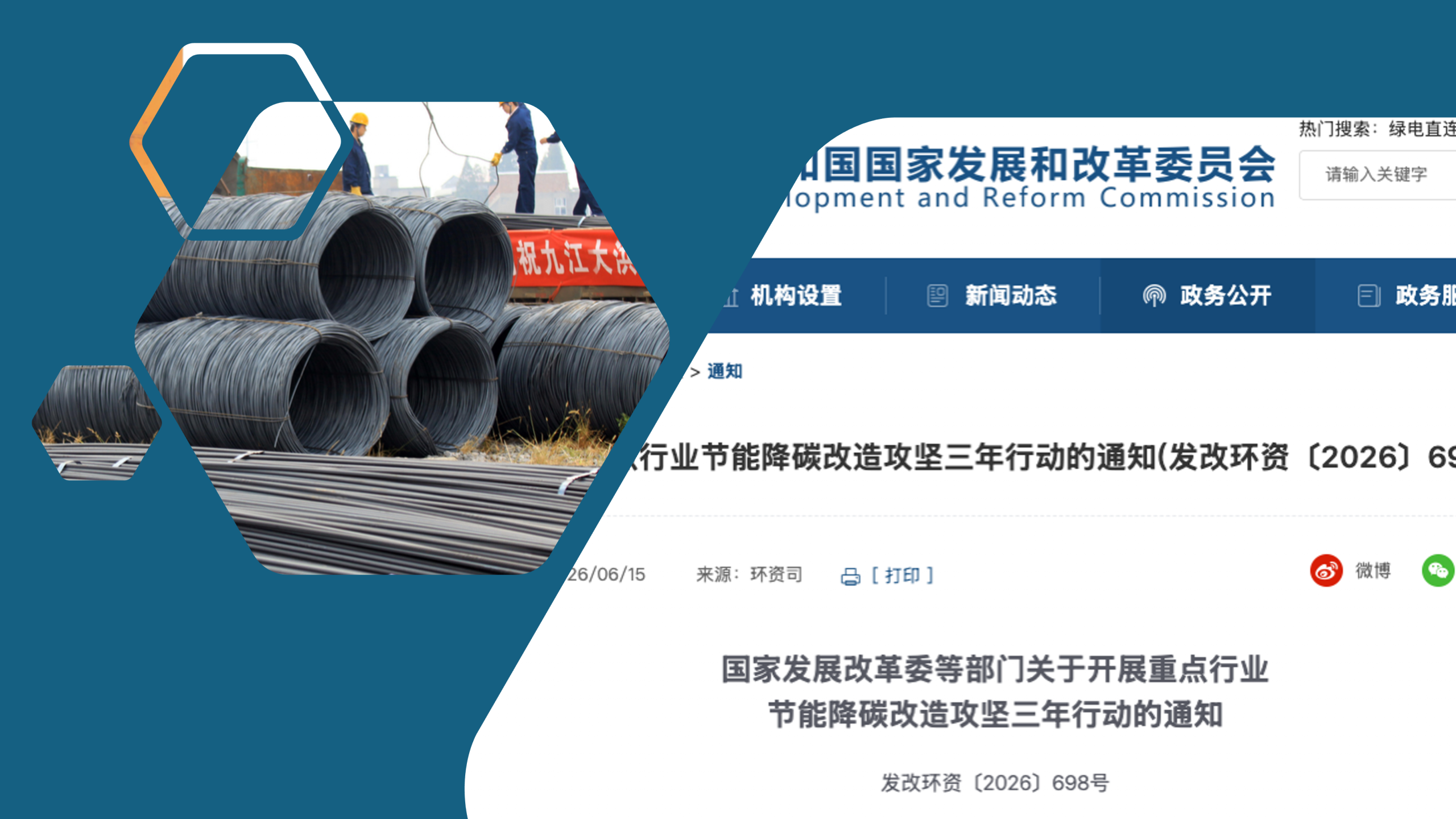
On 15 June 2026, China’s National Development and Reform Commission (NDRC), alongside the Ministry of Industry and Information Technology (MIIT), the Ministry of Ecology and Environment (MEE), the State-owned Assets Supervision and Administration Commission (SASAC), and the National Energy Administration (NEA), issued the Notice on Launching a Three-Year Action on Energy-Saving and Carbon-Reduction Retrofits in Key Industries, along with its accompanying Action Plan.
This notice aims to reduce energy and resource use, cut carbon emissions, and support investment in industrial upgrades. It focuses on nine energy- and carbon-intensive industries: steel, electrolytic aluminum, cement, flat glass, oil refining, ethylene, synthetic ammonia, methanol, and coal power.
Crucially, the notice targets the upgrade and retrofitting of existing operational plants and the elimination of sub-standard facilities, rather than new greenfield capacity. Across all covered sectors, the plan seeks to generate cumulative energy savings of over 100 million tonnes of standard coal and reduce carbon dioxide emissions by more than 200 million tonnes.
To achieve this, the notice establishes a strict framework of incentives, penalties, and governance spanning multiple central ministries alongside provincial governments and their agencies.
This interpretation focuses on the implications for China’s steel industry, though identical policy mechanisms will shape outcomes across the aluminum, cement, chemical, and coal power sectors.
The Impact of the Notice on China’s Steel Sector
The overarching goal of the notice is to strengthen energy conservation, accelerate carbon reduction, and expand investment across China’s heavy industries. By addressing incentives, financing, and compliance standards, it establishes a rigorous framework for oversight and enforcement.
The central signal can be interpreted as follows: China’s next phase of industrial decarbonization will be driven by upgrading its existing asset base.
The document does not frame steel decarbonization around large-scale greenfield replacement, rapid hydrogen adoption, or immediate structural transformation. Instead, it focuses on retrofitting existing assets with advanced technologies. These include high-proportion pellet smelting in blast furnaces, top-pressure recovery of blast furnace gas, oxygen-enriched combustion in hot blast stoves, and inter-process interface technologies like “one ladle to the end” hot metal transportation, alongside waste-heat recovery and surplus-energy power generation.
The document specifies that smaller, older infrastructure will be prioritized for mandatory upgrading or phase-out, specifically targeting:
- Top charged coke ovens with a carbonization chamber height of less than 6 meters (stamp charged coke ovens of less than 5.5 meters),
- Pelletizing equipment under 1.2 million tons/year,
- Blast furnaces below 1,200 cubic meters, – ,
- Converters below 100 tons,
- Electric arc furnaces below 100 tons (50 tons for alloy steel), and –
- Older, inefficient captive coal-fired power units.
Incentive System
Eligible retrofit projects can receive central government subsidies covering 20 percent of verified total investment, with funding priority given to plants that reach benchmark efficiency levels post-renovation.
Local governments are urged to mobilize existing funding channels, supported by tax incentives and green financial products. Financial institutions are explicitly tasked with diversifying their offerings to support this industrial transition.
The notice integrates closely with China’s Emission Trading System (ETS) through a mix of free and paid allowance allocations. Designed to “incentivize the advanced and push the laggards,” the policy awards preferential ETS allowances to enterprises operating cleaner than the benchmark values, allowing them to generate revenue from allowance sales.
However, a notable loophole allows local governments to use the carbon and energy savings generated by these retrofits as emission capacity clearance to approve new, expanded, or renovated “dual high” (high-energy-consumption and high-emission) industrial projects within their region.
Penalty System
The notice introduces clear financial penalties for underperformers by allowing provinces to levy electricity surcharges of up to RMB 0.1/kWh (approximately 0.014 USD/kWh) on top of market prices. As reported by Caixin, this consolidates scattered tiered and punitive pricing systems into a unified policy. Caixin notes that these surcharges could inflate production costs by up to 1,400 yuan per ton, potentially adding 400 million yuan in annual expenses for a mid-sized facility producing 300,000 tons per year.
This is a significant regulatory signal because it embeds energy discipline directly into daily cash operating costs, which are harder to manipulate than the emission intensity metrics often used in the ETS.
The notice specifies that assets failing to meet mandatory energy-consumption standards must complete upgrades by the end of 2028. Facilities that fail to do so, or remain non-compliant after renovation, will face mandatory closure.
Governance
Implementation will be coordinated jointly by the NDRC, MIIT, MEE, SASAC, and NEA. Provincial authorities must design detailed, enterprise-level retrofit plans, submit annual progress updates, and handle local enforcement. Fraudulent reporting or non-compliance will face legal penalties.
SASAC will mobilize central state-owned enterprises to lead by example, while top-performing “front runners” in energy and carbon efficiency will receive public commendations and additional targeted incentives.
How the Notice fits within other Chinese decarbonization and green economy policies
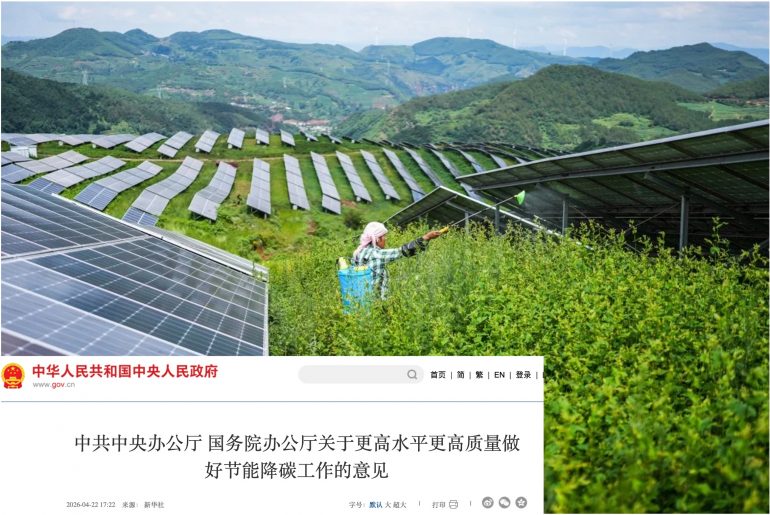
This policy continues a wave of decarbonization and energy-saving measures issued immediately after the release of the 15th Five-Year Plan in March 2026 (interpretation here). Recent precursors include the May 2026 “Opinions on Doing a Higher-Level and Higher-Quality Job in Energy Conservation and Carbon Reduction” jointly issued by the General Office of the CPC Central Committee and the General Office of the State Council (interpretation here), and a stricter steel capacity replacement plan issued the same month, which mandates a nationwide capacity replacement ratio for pig iron and steel production of 1.5:1.
Implications for China’s Steel Stector
For the steel sector, the notice highlights the central government’s resolve to force efficiency gains. For producers facing weak margins and softening demand, the penalty-and-incentive structure makes retrofitting existing plants more financially viable than delaying investment or seeking approvals for entirely new facilities.
Key long-term implications for the steel sector in China include:
- Large-scale existing assets capable of efficient upgrades will remain the bedrock of the sector’s near-term transition, provided they can reach benchmark performance.
- Smaller, older units face a accelerated path toward closure driven by punitive power costs, stricter scrutiny, and firm compliance deadlines.
- Financial institutions and local authorities gain a clearer framework to distinguish between transition-aligned steel assets and high-risk assets vulnerable to becoming stranded.
- The convergence of retrofit mandates, carbon pricing, and strict capacity replacement rules will likely accelerate corporate consolidation across the steel sector over the next three years.
Outlook
This three-year plan marks the beginning of a highly detailed implementation phase rather than the culmination of a policy cycle. It aligns with China’s broader regulatory pattern, where macro green-development targets are systematically translated into granular sectoral rules, performance metrics, and strict localized enforcement.
For the steel industry, further granular policies will emerge over the next three years regarding verification standards, localized power surcharges, and how ETS compliance links to new project approvals. Ultimately, the June 2026 plan represents a permanent tightening of the regulatory floor for heavy industry, with steel serving as the primary testing ground.

Dr. Christoph NEDOPIL WANG is the Founding Director of the Green Finance & Development Center and a Visiting Professor at the Fanhai International School of Finance (FISF) at Fudan University in Shanghai, China. He is also a Professor at The University of Queensland and the lead for Asia Pacific Industry Transitions.
Christoph was a member of the Belt and Road Initiative Green Coalition (BRIGC) of the Chinese Ministry of Ecology and Environment. He has contributed to policies and provided research/consulting amongst others for the China Council for International Cooperation on Environment and Development (CCICED), the Ministry of Commerce, various private and multilateral finance institutions (e.g. ADB, IFC, as well as multilateral institutions (e.g. UNDP, UNESCAP) and international governments.
Christoph holds a master of engineering from the Technical University Berlin, a master of public administration from Harvard Kennedy School, as well as a PhD in Economics. He has extensive experience in finance, sustainability, innovation, and infrastructure, having established the Green Belt and Road Initiative Centre at the International Institute of Green Finance (IIGF) in Beijing, having worked for the International Finance Corporation (IFC) for almost 10 years and being a Director for the Sino-German Sustainable Transport Project with the German Cooperation Agency GIZ in Beijing.
He has authored books, articles and reports, including UNDP's SDG Finance Taxonomy, IFC's “Navigating through Crises” and “Corporate Governance - Handbook for Board Directors”, and multiple academic papers on capital flows, sustainability and international development.